
Fulbright Specialist, Amy Potter, Ph.D., brings global sustainability, international collaboration to classroom
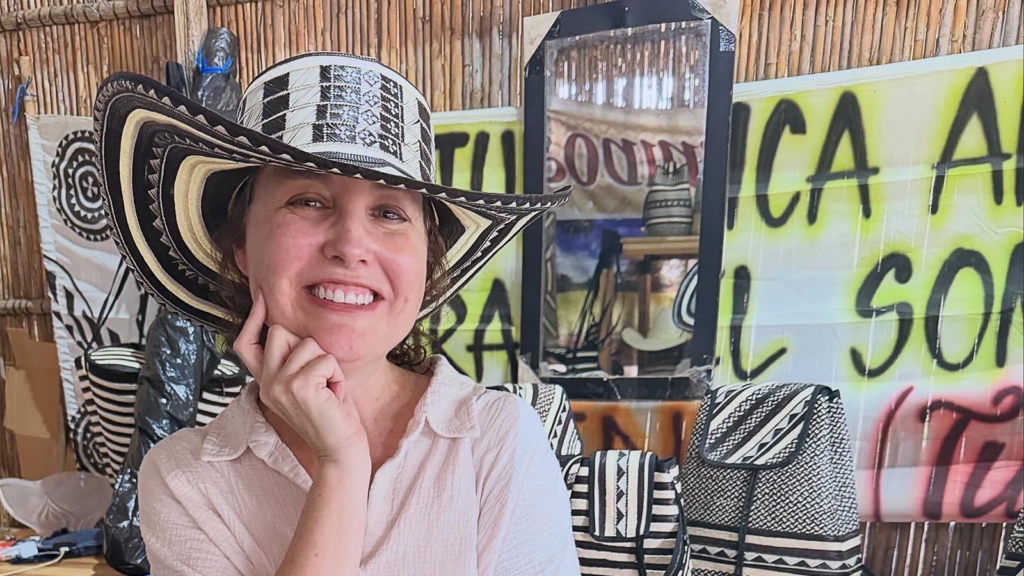
Amy Potter, Ph.D., professor of geography in Georgia Southern University’s College of Science and Mathematics, is the latest Georgia Southern University faculty member to serve as a Fulbright Specialist. Part of the broader Fulbright Program, the specialist designation supports short-term, project-based collaborations between U.S. scholars and international institutions.
Earlier this year, Potter traveled to the Northern Colombian city of Monteria as a Fulbright Specialist and contributed her expertise to “Colombia–U.S. Dialogue on Global Water & Sustainability,” a collaborative, online, international learning (COIL) experience — an educational model that connects faculty from international institutions to design courses around shared topics.
It examines the effects of economic growth on environmental and cultural sustainability. The idea originated with Aura Garcia, a faculty member at Pontifical Bolivarian University–Montería (UPB–Montería).
Garcia chose Potter as her collaborator after being impressed by her previous work in cultural sustainability.
“I wanted Amy after seeing her work in tourism and her efforts in Ireland trying to preserve the culture of the family farm,” she said.
Culminating in a four-week class for Potter and Garcia’s students this fall, the COIL experience will focus on southeast Georgia and members of the Indigenous Zenú community, whose pre-Columbian roots are in and around present-day Montería.
Potter spoke specifically about the reality in southeast Georgia, acknowledging Bulloch County’s growth over the last two decades.
“Development brings incredible opportunities, including much-needed jobs for a region like ours, but it also creates pressure, especially on our water resources,” she explained. “The key question is whether our water systems can sustain that growth over time.”
Garcia painted a similar picture for the city of Monteria.
“The population has grown, and we’ve seen increased revenue and improved infrastructure,” she said. “The Zenú people are definitely feeling pressure. They are still trying to figure out how their culture fits in this development.”
Potter saw this firsthand when she visited the town of Tuchín. Located about 30 miles northeast of Montería, the town has a predominant Zenú population. It serves as a production site for the sombrero vueltiao. The headwear, which has been made by Zenú artisans for centuries, is known for its vibrant color and intricate design.
“I had the opportunity to participate in a workshop with artisans who make this sombrero,” she said. “In 2004, it was designated a national symbol of Colombia.”
Made from a native plant called caña flecha, Potter said this beloved cultural symbol is under threat from “different kinds of water issues,” including access to clean water.
Despite these challenges, the community and its traditions are still enduring, according to Potter. She recalled her visit to the Association of Producers for the Rehabilitation of Agricultural Productivity as an example of this endurance. The agricultural group, located roughly 47 miles north of Monteria, replicates the canals and the ancient hydraulic systems created by the Zenú people.
“The raised land protects the crops from floods and creates food security for Zenú families,” she explained. “These tried-and-true ancestral practices are what’s creating resilience today.”
Reflecting on her time in Colombia, Potter noted how meaningful it is to learn from different cultures, perspectives and histories.
“Having the opportunity to interact with and learn from the Zenú people in this epicenter of Colombian culture was deeply moving,” she said. “I’m also pretty excited about the viewpoint we’re going to bring.”
Potter hopes the students will have a similar experience in the class later this year.
“This will be a unique experience,” Garcia added. “It’s the first time we are offering collaborative classes with an American institution, and students are eager to learn how other places address water sustainability.”