
Georgia Southern University unveils state-of-the-art humanoid robot to redefine engineering education and research
There’s a new resident on campus, housed in the University’s Allen E. Paulson College of Engineering and Computing (AEPCEC): a cutting-edge humanoid robot designed to serve as a cornerstone for advanced research and applied, hands-on classroom learning for students.
The humanoid robot expands the University’s robotics and artificial intelligence (AI) initiatives. Unlike traditional industrial robots, the platform is designed to interact in human environments, giving students and faculty opportunities to study human-robot interaction, machine learning and autonomous navigation.
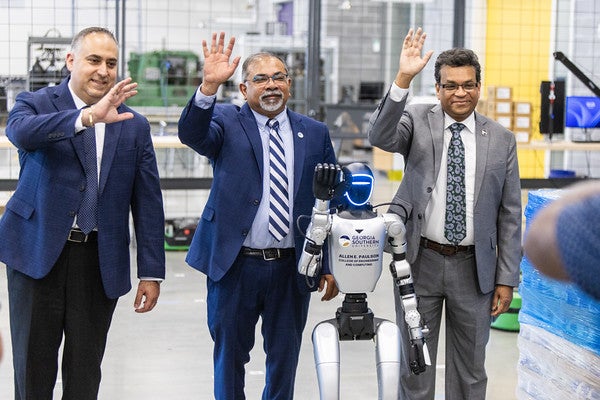
“This is more than just a piece of equipment; it is a catalyst for innovation at Georgia Southern,” said Rami Haddad, Ph.D., former interim dean of AEPCEC and chair of the Department of Electrical and Computer Engineering.
Students across multiple disciplines, including computer science, mechanical engineering, electrical engineering, and information technology, will collaborate on programming, maintaining and optimizing the platform.
“By integrating this humanoid robot into our classrooms and research laboratories, we are giving students hands-on experience with the technologies that are transforming engineering, computing and industry across the world,” said Haddad.
Those capabilities position Georgia Southern graduates to help meet the growing demand for talent at the region’s logistics centers, automated ports and advanced manufacturing facilities.
“Investments in advanced technologies like this humanoid robot reinforce Georgia Southern’s commitment to preparing students for the future of work while strengthening the University’s impact on the region,” said Avinandan Mukherjee, Ph.D., provost and executive vice president for Academic Affairs.
“Providing students and faculty with access to state-of-the-art robotics and AI platforms, we are expanding opportunities for innovation that will help support the continued growth of advanced manufacturing, logistics and intelligent automation throughout Coastal Georgia and the broader region.”
The humanoid robot will be housed in a specialized, multidisciplinary laboratory that will serve as a shared resource for undergraduate projects, master’s theses and faculty-led research.
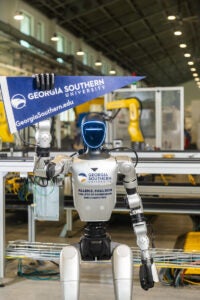
“Our new robot will enhance interdisciplinary research, strengthen experiential learning and equip our graduates with the knowledge and expertise needed to lead in the rapidly evolving fields of robotics, automation and artificial intelligence,” said Abhijit Bhattacharyya, dean of AEPCEC.
The campus community may also catch a glimpse of the robot going to class, working in the labs and walking around campus.
For more information about the AEPCEC and its robotics programs, visit georgiasouthern.edu/cec.