Tactical Athlete Initiative teams up with ROTC to boost cadet training
What can a handheld grip test reveal about military readiness? According to Georgia Southern University researchers, it turns out quite a lot.
It’s one of several tools Georgia Southern University’s Tactical Athlete Initiative (TAI) is using in partnership with the University’s Army ROTC program to improve how cadets train.
Under the direction of Professor of Exercise Science Bridget Melton, Ed.D., and Associate Professor and Director of Tactical Performance Joseph Kardouni, Ph.D., DPT, and supported in part by a Medical Technology Enterprise Consortium (MTEC) grant, the initiative brings in researchers to enhance military training through fitness assessments.
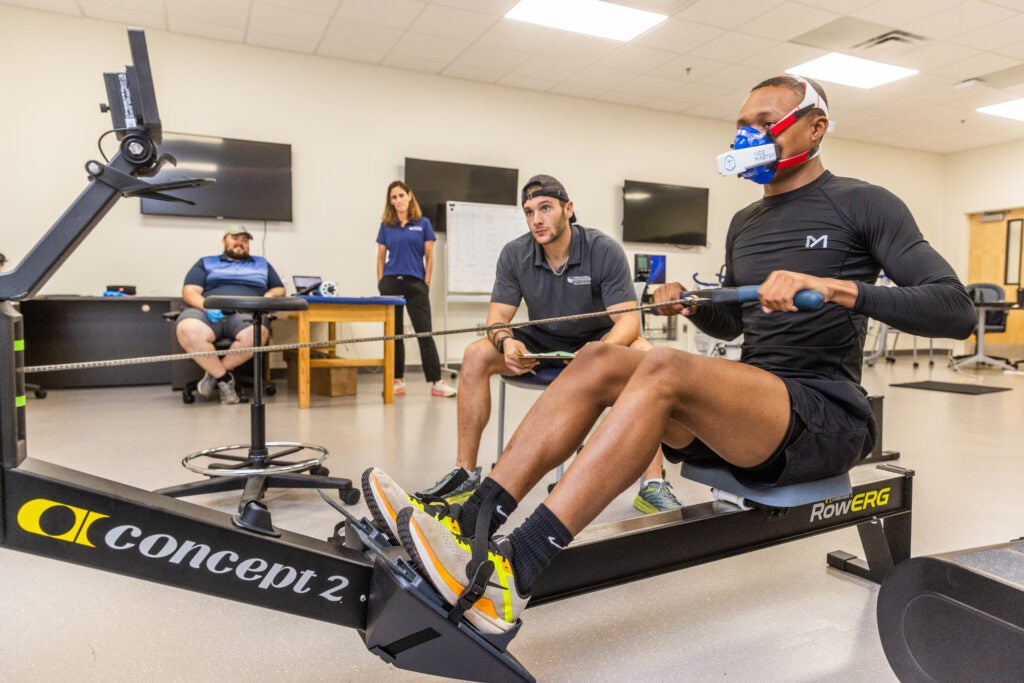
Cadets complete a series of physical tests – such as rowing and jumping – while wearing top-of-the-line monitoring equipment. Data is collected during these assessments and then analyzed by TAI researchers to provide individualized training enhancements for cadets.
Graduate coaching education student Spencer Boling is leading this effort as the first graduate assistant assigned to the TAI.
“It has been nothing short of special,” Boling said. “Being the first in this role means I am actively building this from the ground up, and there is a real responsibility that comes with that.”
Student Jacob Mullins supports the collaboration by helping calibrate the VO2 Master testing system – a mask that measures oxygen intake in real time and gives highly accurate data on aerobic capacity.
“It is fun to be a part of a team doing something meaningful like gathering data,” Mullins said. “It gave me a better understanding of performance testing and the importance of teamwork and preparation.”
One of the initiative’s biggest highlights was placing ninth at the Ranger Challenge, a regional military skills competition, a result of the work put in at the lab.
“A top-10 finish is a genuine achievement and a direct reflection of the cadets’ commitment to physical preparation,” Boling said. “Watching a cadet hit a personal record in the weight room, seeing them pass their Army Fitness Test with flying colors, or simply noticing them develop healthier daily habits are all moments that remind me exactly why this work matters.”
For Boling, the initiative has been transformative both in and out of the lab.
“This collaboration has changed the trajectory of my career,” Boling added. “I always thought I wanted to work in traditional sports, but after seeing the impact of training the tactical population, people who rely on fitness for life and service, I know this is where I belong.”