Ph.D. student wins national fellowship for high-efficiency energy innovation
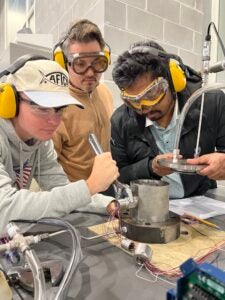
Mohammad “Fuad” Hassan, a Ph.D. student in Georgia Southern University’s Allen E. Paulson College of Engineering and Computing, has been awarded the 2026 Society of Tribologists and Lubrications Engineers (STLE) Elmer E. Klaus Fellowship. The $5,000 fellowship supports his research in developing “smart,” self-adjusting sealing technologies for supercritical carbon dioxide turbomachinery, an innovation designed to boost the efficiency and reliability of clean energy power plants.
The Klaus Fellowship is a nationally competitive award presented by STLE, one of the world’s leading professional societies in tribology, lubrication engineering and sealing science.The award highlights the growing national recognition of Georgia Southern’s research efforts in tribology, sealing technology and advanced energy systems.
“This fellowship reflects the high quality of Hassan’s research and the strong momentum of our tribology program,” said Sevki Cesmeci, Ph.D., associate professor of mechanical engineering and director of the University’s Thermo-Fluidic Systems Laboratory. “Our group is actively engaged in federally funded projects related to supercritical CO₂ power cycles and advanced sealing technologies in collaboration with national laboratories. Recognition from STLE confirms that our students are contributing to research areas that are strategically important for future U.S. energy systems.”
Under Cesmeci’s mentorship, Hassan conducts vital research into advanced elastohydrodynamic (EHD) sealing technologies for supercritical carbon dioxide (sCO₂) turbomachinery. Specifically, he is designing high-tech seals for power plant machinery that uses “supercritical” carbon dioxide to generate electricity. By using advanced computer modeling and physics, Hassan is creating “smart” seals that can automatically adjust themselves to prevent leaks.
“I am grateful to my peers and especially to my supervisor, Dr. Sevki Cesmeci,” said Hassan. “This achievement would not have been possible without his guidance, encouragement and inspiration. He has always supported me and shared opportunities that have helped me grow as a researcher.”
This technology helps the U.S. Department of Energy build power plants that last longer and run more efficiently. Hassan is already well-known in this field, having authored over 15 professional research papers for major engineering journals and conferences. Awarded annually to a single researcher by the STLE Presidential Council, the award recognizes exceptional research with significant potential for impact in the fields of energy, aerospace, manufacturing and transportation technologies.
According to Jack McKenna, immediate past president of STLE and chair of the Presidential Council, the selection process for the fellowship is highly competitive. “Members of the Presidential Council had the difficult task of selecting one recipient from many well-qualified applicants,” said McKenna. “The Selection Committee was impressed with [Hassan’s] application and current research activities.”
Hassan will be formally recognized at the 80th STLE Annual Meeting and Exhibition, to be held in May in New Orleans, Louisiana, where leading researchers and engineers from academia, industry and national laboratories gather to present advances in tribology and lubrication engineering.