
Doctoral graduate aims to destigmatize children’s mental health in Caribbean with support from Georgia Southern’s College of Education

As a school psychologist, Ambah Kioko, Ed.D., has grown accustomed to finding creative solutions to help children process complex mental health challenges.
That spirit of innovation would lead her to Georgia Southern University’s Doctor of Education in Curriculum Studies program, where she will officially graduate in fall 2025.
“I love Georgia Southern because the University makes you think outside the box,” she said. “Professors challenge students to face the question, ‘Whose knowledge is it?,’ which refers to the ownership and distribution of knowledge.”
Having immigrated from Trinidad and Tobago, Kioko is keenly aware of the stigma that mental health carries among Caribbean families. But when designing her doctoral dissertation, the process of effectively changing that stigma piqued her curiosity.
“It made me look into Caribbean history and how change has historically come about there,” she said. “Growing up in the Caribbean, everyone knew about folklore and storytelling. But, I didn’t realize the extent to which communities had utilized storytelling as a method of driving change,” Kioko explained. “When enslaved Africans came to the Caribbean, they were able to send messages and drive change through storytelling, which provided hope for a better future.”
By utilizing historic, and cultural methods of information sharing through storytelling, the stigma surrounding mental health can be better understood and overcome.
While conducting her research, Kioko developed a unique methodology to better collect, analyze and assess data providing a new way to address and dismantle the stigma surrounding mental health in the Caribbean.
“I want to help others think outside the box. How can we reach that next level of understanding through traditional storytelling? The future of research is limitless.”
With the encouragement of faculty, she is hoping to publish her methodology making it more accessible for other scholars. Her goal is to help researchers drive change in the Caribbean’s mental health system and improve the lives of children seeking help.
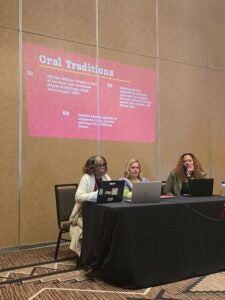
For Kioko, earning an Ed.D. means opening pathways for new opportunities in educational settings while also establishing a solid foundation for participation in future research projects, expanding her knowledge as a school psychologist and researcher.
Kioko attributes the University’s flexibility and encouragement throughout the program with completion of her doctoral dissertation which allowed her to study and assess an area of research that held both personal and professional significance.
“I ultimately chose Georgia Southern because the program was able to work with my schedule,” she said. “They had classes when I was off in the summertime during one weekend a month, so I was able to keep working full-time while pursuing my Ed.D.”
Although she says working full-time while earning a doctoral degree is challenging, Georgia Southern’s hybrid model blends rigorous coursework with realistic expectations for working professionals.
“I tell some of my psychologists that, if they’re looking for a good, helpful program, they should consider going to Georgia Southern,” Kioko said. “I wanted to be able to have my experience be both online and in-person, and the program allows a good combination of both.”
In December, Kioko will officially be a graduate of Georgia Southern’s Doctor of Education program after several years of determination, dedication and a commitment to learning. Although her journey as a student will come to an end, with her newly awarded doctoral degree, her work as an educator, scholar and changemaker are about to take flight.