
A research first through the Waters College of Health Professions gives physical therapists a new resource in assessing and treating patients
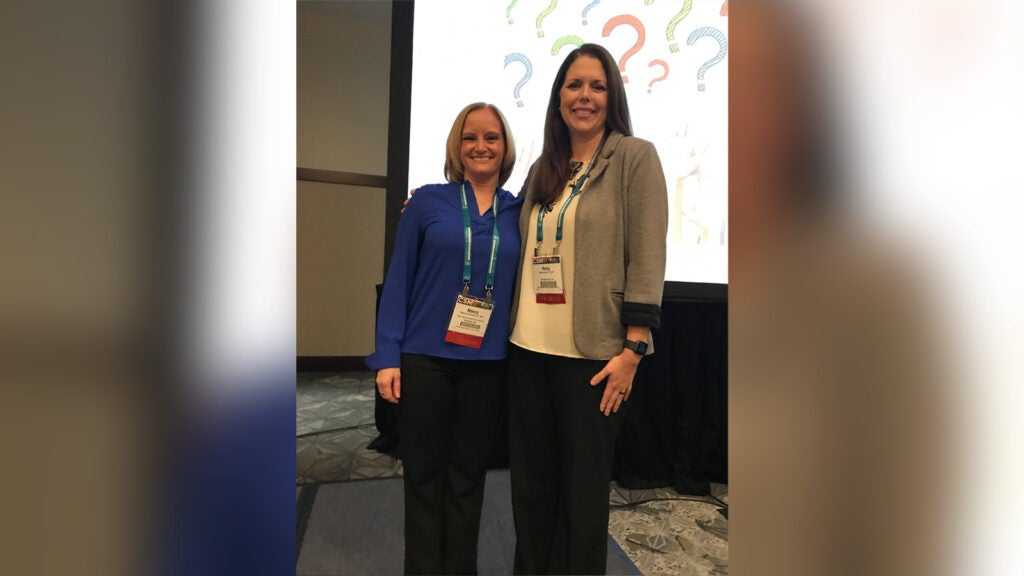
A new study authored by faculty from Georgia Southern University’s Waters College of Health Professions (WCHP) is the first to establish baseline data for the single-leg bridge (SLB) in healthy young adults. This gives physical therapists a tool that was previously missing from patient treatment, said Assistant Professor Nancy Henderson, DPT.
“Physical therapists have to set goals for their patients,” she explained. “You would normally start with what a typical, healthy individual is able to do, but we didn’t have those numbers until now.”
The research is also notable for being the first to accurately assess the SLB without expensive electromyography equipment. The new data makes the exercise more accessible and practical, according to Henderson.
“Knowing that you can accurately measure this kind of position, regardless of clinic finances, is really valuable,” she said.
Henderson, who is an assistant professor in WCHP’s Department of Clinical Sciences, collaborated with her colleague, Haley Worst, DPT. Together, they observed 77 healthy participants after a five-minute warm-up and video demonstration. The group was majority female and had an average age of 20.
Results showed that the average for a participant’s dominant leg was 65.2 seconds. For the nondominant leg it was 63.9 seconds. They were allowed two-minute breaks between tests.
These findings were highlighted in “Establishing Normative Values and Clinician Assessment Accuracy for the Single Leg Bridge Endurance Test.”
Published this year in the “International Journal of Sports Physical Therapy,” the article also states that the muscle groups activated during the SLB, trunk and pelvic “have been recognized as indicators of fitness and injury risk, particularly in high-performance populations such as military personnel.”
Worst, who is an associate professor and director of the DPT program, emphasized this specific application. She and Henderson have more than a decade of experience working with members of the armed forces and say having baseline data will be a major asset in treating this population.
“Because it holds our body up all day long, the core actually benefits more from endurance tests and training,” Worst explained. “If they have chronic pain or some sort of functional instability, their endurance strength is going to tell me a lot more about their ability to do their job.”
The duo acknowledged this research is just a starting point, but are hopeful the University’s research support will allow them to do more.
“When you teach a full course load, it’s hard to find the time,” Worst said. “With more support and resources, it’s easier to devote that time to research. Ultimately, I hope that our work now and in the future will help improve clinical practice through evidence.”