
Georgia Southern, Georgia Tech collaborate on real-time hydration monitoring for athletes
Georgia Southern University is collaborating with the Georgia Institute of Technology to develop a hydration-monitoring device for athletes, as part of a broader effort to improve player safety and performance. Georgia currently ranks first nationally in preventing heat-related illness and death among athletes, and the two universities are working together to build on that success.
Faculty from Georgia Southern’s Waters College of Health Professions (WCHP) and Georgia Tech’s George W. Woodruff School of Mechanical Engineering are partnering with Georgia Southern’s football program to develop a soft, wearable patch that will measure players’ hydration levels in real time. The device helps athletic trainers monitor health risks during games and practices more quickly than traditional methods.
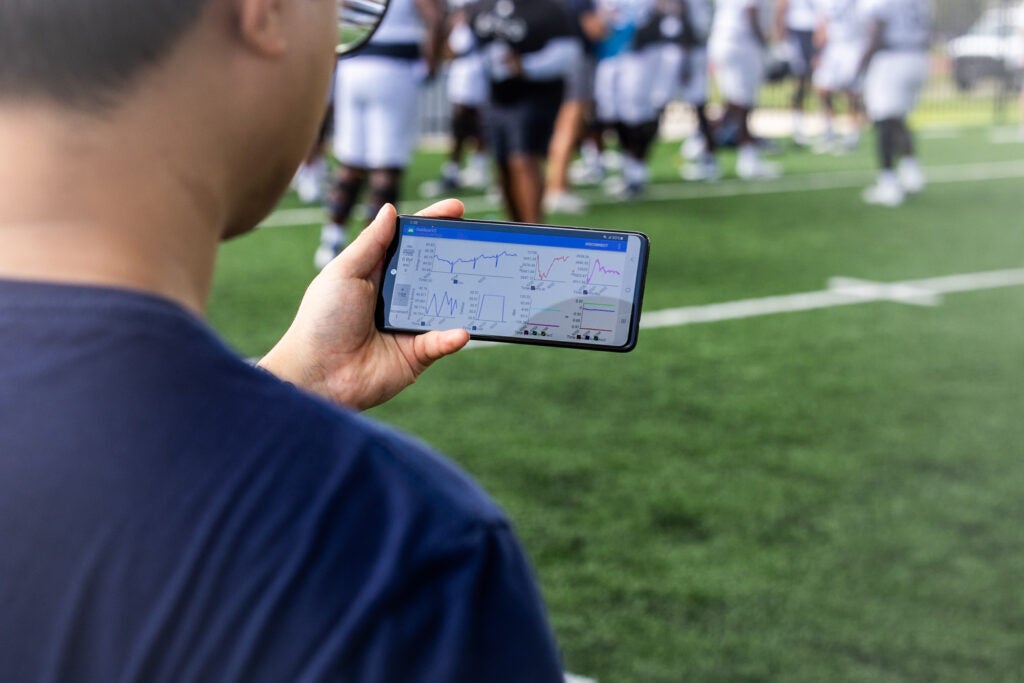
Using embedded sensors, the patch transmits physiological signals related to heat stress and metabolic rates via Bluetooth to the sideline. This gives athletic trainers immediate feedback, unlike delayed techniques such as urine analysis and pre- and postgame weigh-ins.
Because health risks from overheating leave no time for delay, immediate data can be critical.
“During intense exercise in the heat, the risk of dehydration and subsequent negative influences on performance and safety risks are increased due to the exacerbation of thermoregulatory and cardiovascular strain,” according to The National Athletic Trainers’ Association.
First developed at Georgia Tech, the patch originated from the research of mechanical engineering Professor W. Hong Yeo, Ph.D. His work initially focused on collecting physiological signals outside of a hospital setting. As interest in digital health care grew, Yeo and his team adapted the device to monitor athlete health and performance.
They needed test subjects. In the fall of 2025, the Georgia Southern football team stepped in to meet that need.
“We are always looking for ways to keep our athletes safe and able to perform at their best,” said Nick Sparacio, Georgia Southern’s head football athletic trainer.
“This sensor can give us data about cardiac rhythm, sweat loss, temperature and physical movement,” Sparacio added. “The old adage, ‘an ounce of prevention is worth a pound of cure,’ is especially true in athletics. With real-time data, we can intervene or provide additional resources to prevent adverse events.”
At various points throughout the season, researchers tested the patch on players during practice.
WCHP Associate Dean of Research and Clinical Sciences Vishakha Rawool, Ph.D., was charged with creating a usability survey for the patch and analyzing the results.
Players complimented the patch’s ease of use and sleek design.
“Putting the patch on took five minutes max,” said freshman quarterback Weston Bryan. “Once I took the field, I completely forgot about it, and it didn’t hinder me at all.”
Ultimately, researchers tracked real-time hydration metrics for eight players over a three-day period. They are finalizing a manuscript to submit to a peer-reviewed journal in a month.
While the patch isn’t currently game-day ready, Yeo and his team are refining the technology. They hope to improve the reliability and accuracy of the data so that it is comparable to that collected in clinical settings. Additionally, researchers are working to make the patch even smaller to avoid its interference with equipment.
“We have already validated the device’s capability to capture both physiological signals and skin hydration levels, and we are refining the design to better suit athletes’ needs,” said Taewoog Kang, a post-doctoral researcher in Yeo’s group. “Recent testing has identified areas for improvement in the prototype, and we are now incorporating these changes before future trials.”
Rawool is hopeful about what the future holds.
“Overall, the usability of the patch is good,” Rawool said. “There’s work to do to ensure it is ready for use during athletic competition, but I view it more as an opportunity to improve rather than a barrier that can’t be overcome. I think it has the potential to be a major step forward in athlete safety.”