Ronald E. McNair scholar, engineering student earns international recognition for advanced energy systems research
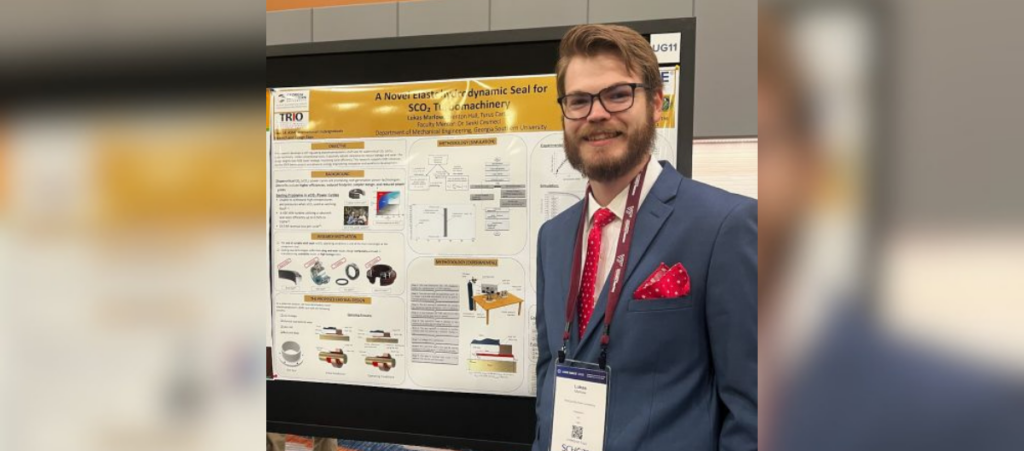
Lukas Marlow, a scholar in the Ronald E. McNair Post-baccalaureate Achievement Program, and engineering student in the Allen E. Paulson College of Engineering and Computing, earned international recognition for his third-place finish in the Undergraduate Poster Competition at the American Society of Mechanical Engineers (ASME) International Mechanical Engineering Congress and Exposition (IMECE).
Each year, IMECE gathers dozens of top researchers from institutions of higher education, government entities and industry to drive innovative engineering solutions for the future. The exposition, which was held in Memphis, Tenn., sought to highlight the necessity of engineering while also recognizing global challenges within the profession.
Marlow’s research was selected among presentations from undergraduate researchers representing universities around the world.
“Coming to college, I never imagined I would be presenting research on an international stage,” he said. “Receiving recognition at IMECE showed me how much I have grown as a student, researcher and communicator. It gave me confidence that I can contribute meaningful work to the engineering community.”
Marlow spent the year researching challenges associated with supercritical carbon dioxide (sCO₂) power generation systems, an emerging technology with potential applications in next-generation energy production. His research focused on sealing behavior within sCO₂ systems, a critical area affecting efficiency, reliability and long-term system performance.
During Marlow’s time at the University, the engineering student has been supported, in part, by the Georgia Southern’s McNair Scholars Program which aims to support undergraduate students, like Marlow, in their pursuit of a Ph.D. These first-generation college students receive resources to better succeed in graduate school, while also championing talented, dedicated and prepared future researchers and faculty.
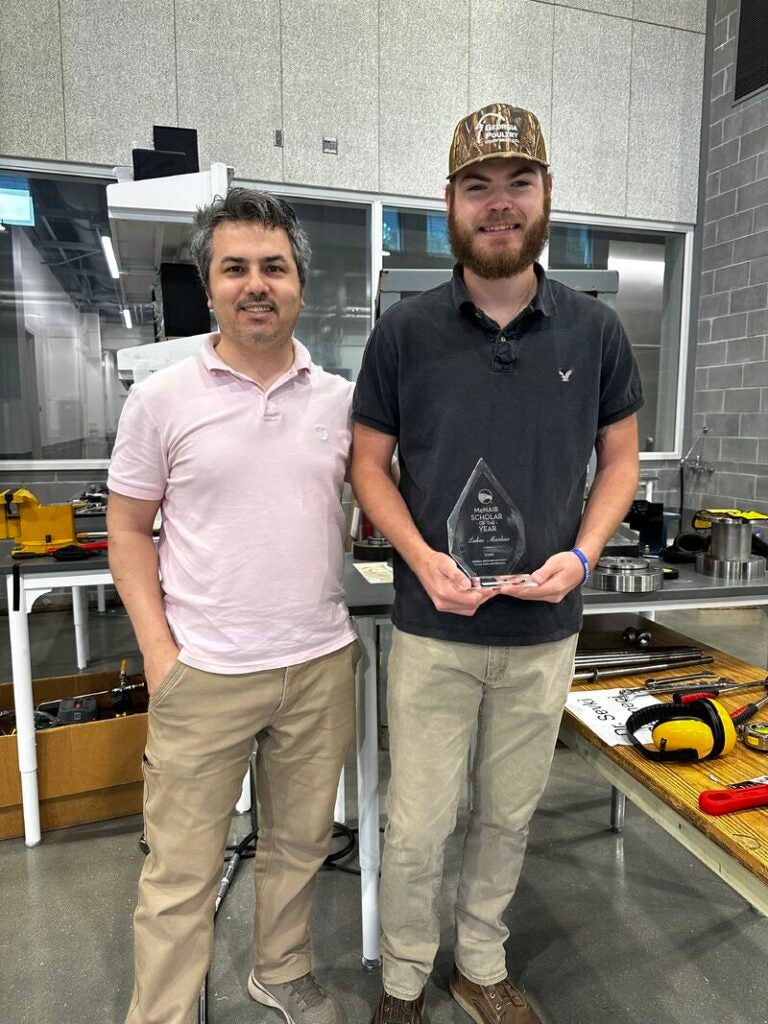
Throughout the experience, Marlow received mentorship from Sevki Cesmeci, Ph.D., associate professor of mechanical engineering and director of the University’s Thermo-Fluidic Systems Laboratory and doctoral student Mohammad “Fuad” Hassan. He later presented his research at several major conferences including the Georgia Undergraduate Research Conference (GURC), ASME IMECE, and the National Conference on Undergraduate Research (NCUR).
In recognition of his academic achievement, research accomplishments and engagement with the program, Marlow was also named Georgia Southern’s McNair Scholar of the Year for the 2025–2026 academic year.
“Lukas approached his research with professionalism, responsibility and determination,” said Cesmeci. “He consistently followed through on his commitments, engaged deeply with the technical challenges and developed confidence as both a researcher and presenter.”
As Georgia Southern continues to strive for R1 status, this project highlights the collaborative nature of undergraduate research within the University. Hassan worked closely with Marlow throughout the project, providing technical guidance and mentorship.
The experience was more than just the high-ranking finish at IMECE. For Marlow, the hours of intensive development and research have helped shape his future goals.
“Research showed me that engineering is about more than solving equations,” he explained. “It’s about solving real-world problems and creating meaningful impact. Presenting at conferences, collaborating with mentors and contributing to a challenging project has prepared me for the next stage of my career, reinforcing my desire to continue growing as an engineer.”
While technology continues to rapidly evolve, students like Marlow exemplify the impact of hands-on research experience during undergraduate studies. For faculty like Cesmeci, the ability to provide students with invaluable skills and resources is both critical and illuminating.
“Undergraduate research allows students to experience real-world engineering problems, which helps develop the skills they need for graduate school, faculty and more,” said Cesmeci. “Watching students grow is one of the most rewarding aspects of academic research.”