
Georgia Southern professor proposes new framework for aging
People are living longer than ever before. The World Health Organization estimates that the number of people aged 60 and over will double from one billion in 2020 to 2.1 billion in 2050.
However, living longer can come with unique challenges, such as declining mobility and difficulty maintaining independence. So, how do we measure how well people live, not just how long?
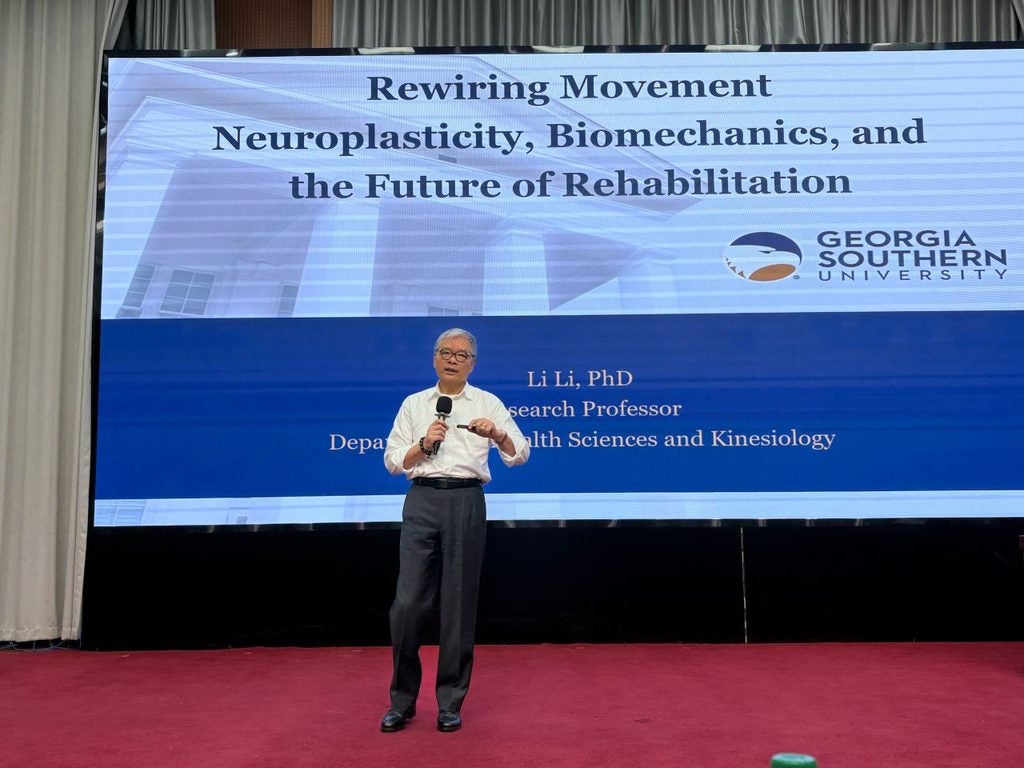
Georgia Southern University Professor of Kinesiology Li Li, Ph.D., has spent decades studying this question, specifically how movement contributes to health and quality of life. In his recently published research essay, “Movement span: Extending the discourse on aging beyond life span and health span,” he proposes a new dimension of aging: movement span.
Movement span refers to how long a person can move confidently, comfortably and independently in their environments. He proposes this as a third dimension of aging alongside two other widely recognized dimensions: life span, how long someone has lived, and health span, the number of years someone has lived free of chronic disease.
But understanding movement span requires looking beyond traditional measures of physical activity.
“Traditional physical activity recommendations focus on how much and how intensely people move, but don’t account for movement variety,” said Li, a Fellow of the American College of Sports Medicine and a faculty member at the Waters College of Health Professions since 2012.
“For example, walking 10,000 steps a day at the same pace along the same route may meet activity guidelines without challenging the body to adapt to different movements. Movement span can be seen in how easily someone adjusts their stride or changes direction to avoid an unexpected obstacle while walking, without losing their balance or needing to stop.”
Li, recognized by Stanford/Elsevier for the third consecutive year as one of the world’s top 2% of scientists with career-long impact, argues that while existing recommendations emphasize the amount and intensity of physical activity, movement variety plays an important role in maintaining mobility and independence.
“Moving well means more than moving a lot,” Li explained. “It means being able to adapt to unexpected changes, transition smoothly between activities and maintain these abilities amid the everyday demands of life.”
Li recommends incorporating movement span into clinical practice and public health assessments. He also hopes to collaborate with technology manufacturers to explore ways to measure movement span through mainstream devices, making it a practical tool for assessing and improving quality of life.
“In doing so, we may come closer to answering what is, ultimately, the most important question in aging: not merely how long people live, but how fully can they inhabit that life,” said Li.