Georgia Southern alumnus lives on through posthumous work
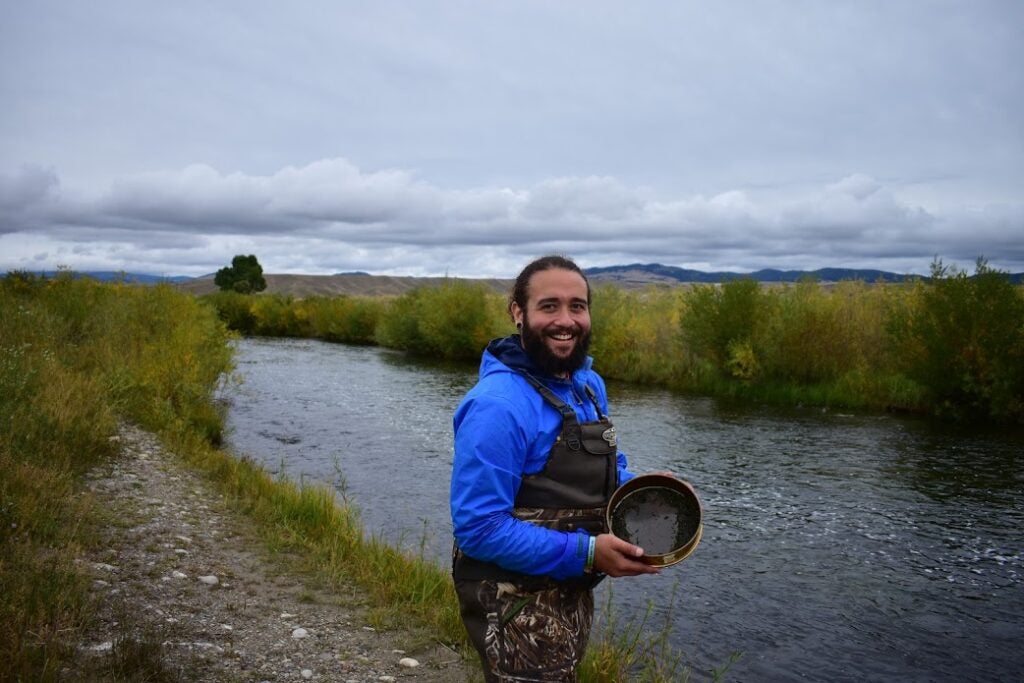
The December 2025 issue of “Freshwater Science” will carry special meaning in Georgia Southern University’s Department of Biology.
The issue will feature a paper with the late GS biology alumnus José Sánchez-Ruiz as the lead author. The paper, “Climate variability affects a vital ecosystem function: Long-term perspective on leaf decomposition in the Ogeechee River,” is the culmination of Sánchez-Ruiz’s graduate research during his time as a master’s student at the University.
Focusing on how environmental changes affect leaf decomposition and their role as an essential food source in aquatic ecosystems, the publication is based on five years of research by Sanchez and his faculty mentor and co-author, Checo Colón-Gaud, Ph.D., professor of biology.
Colón-Gaud says there is cause for celebration any time a student is published. This work, however, is particularly meaningful since it is being published posthumously.
“I know that all of our students hold a very special place in our lives, but with José it was even more,” he said. “We were both from Puerto Rico, worked in similar systems and with some of the same people, and we shared some unique experiences. This means a lot to me personally.”
After graduating from Georgia Southern, Sánchez-Ruiz pursued a doctorate in ecology at Montana State University. He passed away in 2023 before completing his degree, and the degree was awarded posthumously later that year.
Originally an art major at the University of Puerto Rico, Sánchez-Ruiz was nearing completion of that degree when two science courses changed the trajectory of his life.
“It was kind of amazing that I could go and explore places that I would never imagine existed,” Sánchez-Ruiz said in 2018. “I thought, ‘So they pay me to be an explorer? To do all of this stuff? To explain the natural world?’ I don’t know. It kind of fit with my personality, and I immediately switched my major to biology.”
In his time as a researcher, Sánchez-Ruiz conducted research across North America and Iceland. A National Science Foundation grant even led to field studies in southern Chile.
In 2016, Sánchez-Ruiz graduated from the University of Puerto Rico with a Bachelor of Science in biology. He decided to further his education at Georgia Southern after establishing a relationship with Colón-Gaud during his undergraduate years.
Having found his passion later than most, Sánchez-Ruiz more than made up for lost time. Upon graduation from Georgia Southern, he published six peer-reviewed papers and received the Averitt Award for Research Excellence, the university’s highest honor for graduate research.
Steve Vives, Ph.D., professor of biology at Georgia Southern and former biology department chair, called him an “emerging star in the field of freshwater ecology.”
As impressive as his academic accomplishments were, Sánchez-Ruiz, affectionately known as “Tosti,” is chiefly remembered as a caring friend who was quick to uplift others.
“He was simply a joy to be around,” said Vives. “He was a leader among the graduate students, sometimes as a mentor and role model, but just as often as someone who would be a good and invested listener. He was truly kind.”
His investment in others wasn’t just limited to his fellow students. Sánchez-Ruiz served as a fellow in the Society of Freshwater Science’s Emerge and Instars programs, which aim to increase representation from historically underrepresented backgrounds in freshwater science.
When asked in a 2018 Georgia Southern interview whether he would recommend a career in biology to those who love science and adventure, he responded with: “Go for it.”
According to his mentor, that three-word phrase captured much of what Sánchez-Ruiz embodied, both in research and in life.
“That was José,” Colón-Gaud said. “He was fearless, intellectually curious and up for anything. This latest publication is indicative of the kind of science José believed in: rigorous, long-term and applicable beyond the boundaries of academia.”